Wednesday, September 23, 2009

Laser Eye Surgery, How does it work?

Laser eye surgery has become more and more popular since it was first introduced over twenty years ago. Most patients that had this surgery were very happy with their results. Some people even said it was the best investment of their life. My big question is why do people say it is dangerous, how does it really work?

The First step to this procedure is for you to go to an ophthalmologist who will examine your eyes to assure you are suitable for this treatment. Once you get cleared by your doctor, either they or an ophthalmic surgeon will do the procedure.

Surprisingly, the surgery does not appear to be too complex. There are many different procedures, but the most common is LASIK eye surgery. In LASIK surgery, the first thing your ophthalmologist will do is give you a local anesthetic to numb your eye ball. A laser is used to make a thin circular flap in the cornea. The surgeon then folds the flap back and removes some corneal tissue using a different laser. The laser also reshapes the cornea while removing some tissue. Once the cornea is reshaped the flap is flipped back into place. This results in improved vision and often vision correction is no longer needed.

I decided to blog about LASIK eye surgery because of NS's blog of the tooth in the eye surgery. Mr. Hazen complimented MS for relating her blogpost to NS so I thought I'd do so too.


My second resource-

Doomsday 2012?

Is the world coming to the end on 2012??


Well according to  these folks the world will end on December 21, 2012. They base their suspicions around an advanced civilization 1700 years ago and the callendar of the Mayans.

So what is the Mayan Calendar that predicted the end of the world?

The calendar was constructed by an advanced civilization called the Mayans around 250-900 AD. Evidence of the Maya empire stretches around most parts of the southern states of Mexico and reaches down to parts of Guatemala, Belize, El Salvador and some of Honduras. The Mayan Prophecy is wholly based on the assumption that something bad is going to happen when the Mayan Long Count calendar runs out. Experts are divided as to when the Long Count ends, but as the Maya used the numbers of 13 and 20 at the root of their numerical systems, the last day could occur on 13.0.0.0.0 . 13.0.0.0.0 represents 5126 years and the Long Count started on 0.0.0.0.0, which matches to the modern date of August 11th 3114 BC.

Have you seen the problem yet?

The Mayan Long Count ends 5126 years later on December 21st, 2012 on our calendars. The Mayan Doomsday Prophecy is purely based on a calendar which we believe hasn't been designed to calculate dates beyond 2012.

But wait there is more!

Mayan archaeo-astronomers are even debating to whether the Long Count is designed to be reset to 0.0.0.0.0 after 13.0.0.0.0, or whether the calendar simply continues to 20.0.0.0.0 (approximately 8000 AD) and then reset.  No one really knows.

Still think the world willend in 2012? I don't.


by KH -  source http://www.universetoday.com/2008/05/19/no-doomsday-in-2012/

Tuesday, September 22, 2009

Monkeys Can Now See In Color


Although female squirrel monkeys can see in color, male squirrel monkeys are usually red-green colorblind because they do not have certain pigments in their retinas that detect those wavelengths of light.  The only way these monkeys might be able to see red and green light is if they are treated with a gene therapy test.  From this, they would be able to hopefully produce the protein needed for them to form a red photoreceptor cell which will allow them to detect the colors red and green.

With this theory, researcher Jay Neitz of the University of Washington in Seattle has taken two male monkeys, named Sam and Dalton, to perform a gene therapy test to see if they could produce the proteins they need to be able to see red and green lights.  Since Sam and Dalton were both lacking the red photoreceptor cell, they were given injections with a virus carrying a gene with the protein.  Over a 20 week period, the levels of protein slowly rised in the retinal cells of both monkeys and their performance on their daily color vision tests improved.  While looking at a gray screen with red and green dots lighting up, Sam and Dalton were able to sense the difference of lights by pointing to where they were on the screen.  Two years after Sam and Dalton underwent this test, they have maintained full color vision and can recognize all colors of light.

Researchers were very impressed that this test worked on adult monkeys and that it did not require any rewiring of the brain.  Even though we do not know what actual colors the monkeys are seeing, scientists do know that they do have a change in what type of color they see through their new photoreceptors.  Many scientists are now curious to see if this test would work on colorblind humans, but the outcome would be unpredictable.


download      download


By E.R.

Was there ever water on Mars?


   For decades, scientists assumed that the reason for Mar's rusty red color was that Mars was probably at one time warm and wet.  Scientists believed that over time the soil on Mars became rusty.  Scientists believed that this process happened because the iron oxide formed from iron in the soil and oxygen in the water.  "Mars should really look blackish, between its white polar caps, because most of the rocks at mid-latitudes are basalt," said Merrison in a release.  Basalt is the kind of rock that is produced by volcanoes, and other sources of earthly heat.  Basalt is almost always dark.


            "So why isn't Mars black?"  An experiment was conducted where flasks were filled with sand (earthly but not terribly different from Martin soil analyzed by Mars landers).    The flasks were sealed would stay dry as dust.  The vials were put in mechanical tumbler, and they were turned over ten million times to simulate the kind of erosion that happens when rock particles are blown around or grind against each other over time.  After several months, the flasks contained reddish dust.  No water was required.  Merrison theorizes that the chemical composition of the dust changed as a result of the constant friction.  The soil became rich in hematite, which is reddish and a form of iron oxide.


            This finding could mean that there was never water or life on Mars.  This was what some scientists had based their theories for life on Mars on.  I think this could put an end to some studies, but this discovery could open a whole knew world of research possibilities.


KH

Friday, September 18, 2009

Blind Woman sees with "Tooth-in-eye" Surgery


Blind Woman sees with "Tooth-in-eye" Surgery


Just recently a team of specialists at the University of Miami Miller School of Medicine announced on Wednesday that they were going to be the first people in America, to restore a person's sight by using a tooth. They used a procedure that is formally called "osteo-odonto-keratoprosthesis," or MOOKP. As far as we know, this procedure only works for people who have become blind due to disease or other problems, such as Sharron "Kay" Thornton, age 60. She had lost her vision due to a rare disorder called Stevens-Johnson syndrome, and her eye became totally damaged.


The first step was for dentist, Dr. Yoh Sawatari, to remove a tooth from Thornton's mouth and prepare for an implant of her own dental tissue for her worse eye. This tissue would be used to make a new cornea to replace the damaged one. The doctors then removed a section of Thornton's cheek to become the soft tissue around the pupil and finally the team implanted the modified tooth with a hole drilled through the center to support a lens, and then they put in an optical cylinder. The doctors had said that since they had used her own tooth and piece of cheek, her immune system would not fight the transplant.


"Her eye looks different, but the goal is that once she's better, we can put on a cosmetic eye shield." says one of the doctors. This "tooth for an eye" technique was developed in Italy in the early 1960s, but it has been modified in Europe ever since. Hundreds of people in Japan, England and Italy have regained their vision, but it was amazing to see it caught up in America. MOOKP is used more often in Europe, but doctors in the U.S. usually choose a less tedious technique called the Boston Keratoprosthesis, which is like this procedure, but uses a prosthetic cornea instead of a tooth and cheek tissue. However, the Boston Keratoprosthesis does not work for all people.

~NS
source


Monday, June 22, 2009

Total Solar Eclipse Darkens America's Heartland

There will be a solar eclipse this summer but you'll have to go to India or China or take a very expensive cruise in order to see much of it...What is a solar eclipse lover to do?
Mark your calendars!
The moon will block the sun's light across the heartland of the United States causing one of the most spectacular Solar Eclipses of our lifetimes.
(I definately need more hype!!!!!!!)

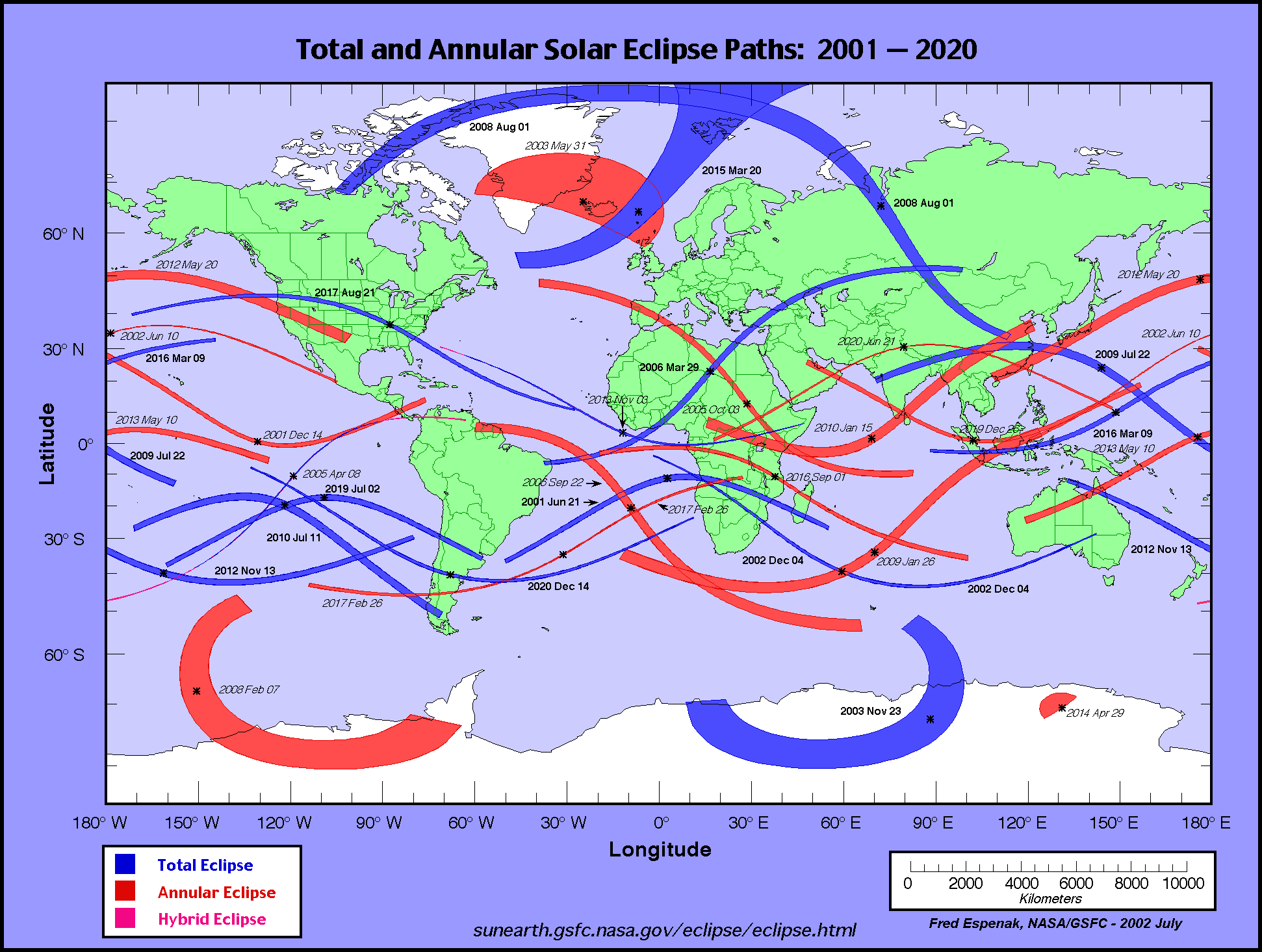
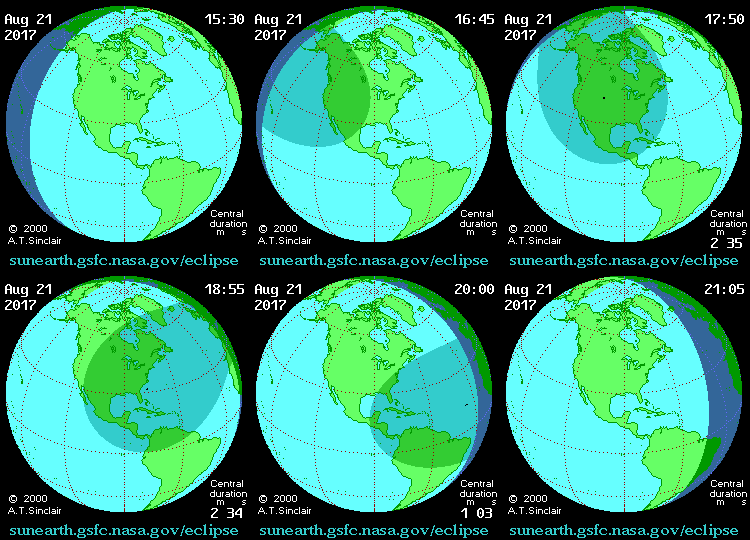
On August 21, 2017 a total solar eclipse that will make landfall just south of Portland, OR about 7:05 AM PDT. Then the moon will blot out the sun across Idaho, Wyoming, Nebraska, Missouri, Tennessee, a bit of Georgia and the Carolinas before moving over the Atlantic at about 2:10 PM EDT
This is sure to be a grand event and, Class of 2010 (Bedminster 8th Grade),  just weeks after your college graduation... What a great college graduation present -- a trip to the eclipse.
(The next  lunar eclipse visible to us will be December 21, 2010 but we'll cover lunar eclipses another time.)

Here are some basic eclipse vocabulary words:
SAFETY PRECAUTION:  DO NOY LOOK AT THE SUN EVEN DURING AN ECLIPSE!  YOU CAN BURN UP YOUR RETINA IN A MATTER OF SECONDS!
total eclipse - the new moon is in a direct line with the sun and blocks the sun's light completely
annular eclipse - the new moon is in a direct line with the sun but only blocks part of the sun's light (Who can make a model that shows why this happens?) leaving a dangerously bright ring of sunlight around the disc of the moon.
hybrid eclipse - a little bit of the total and a little bit of annular over the period of the eclipse
partial eclipse - only part of the sun light will be blocked. The sun will look like a cookie with a bite out of it.

Optional: Check wikipedia for more details, a tutorial with good illustrations from Mr. Eclipse or NASA 

Definately view this animation that shows how the shadow of the moon crosses the earth.

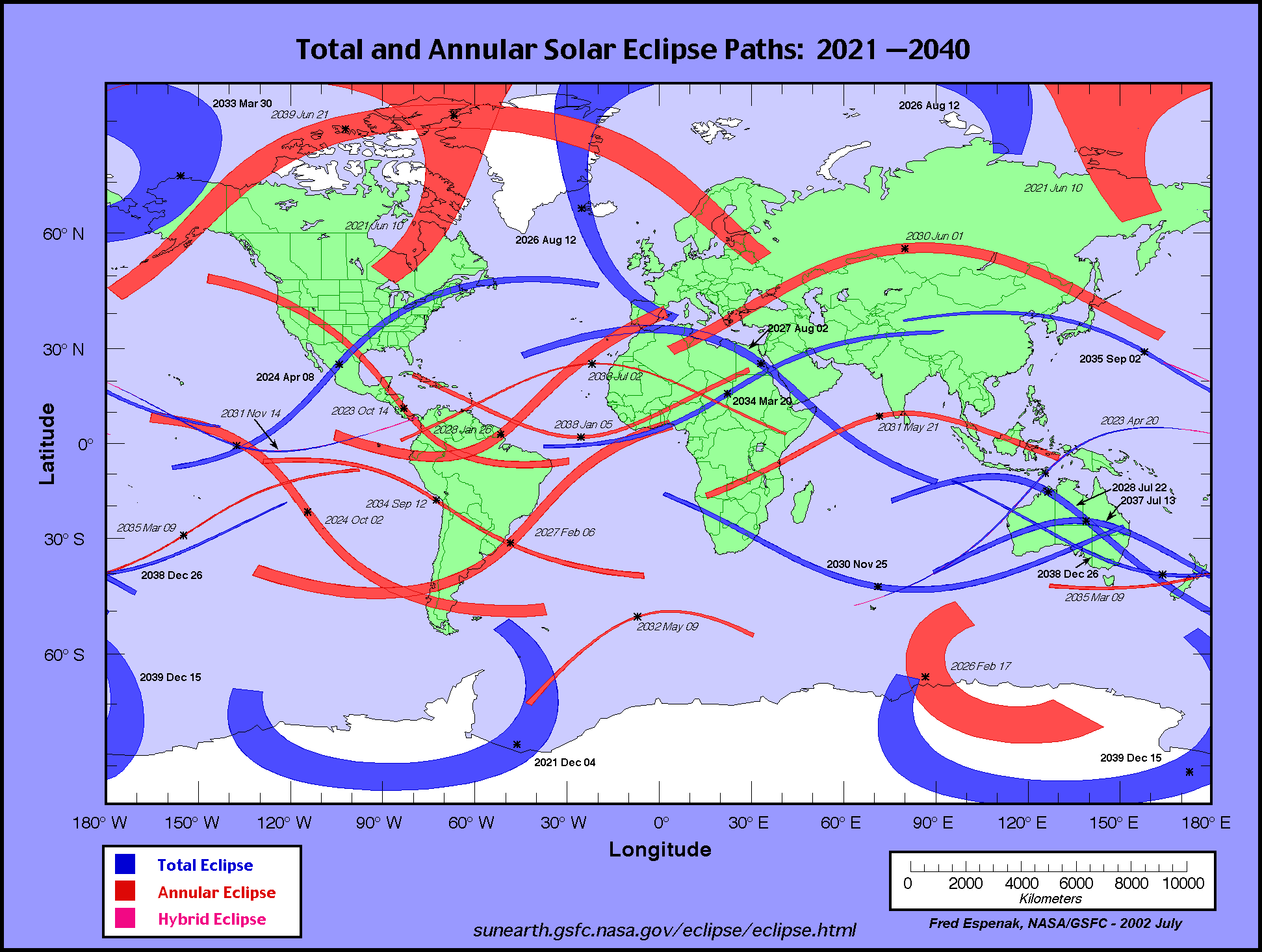
The next solar eclipse to darken the continental USA will be April 8, 2024.  That Eclipse makes landfall in the southwest of Mexico and crosses the continent heading toward the north east.  The path of these two shadows makes an X in the heartland of the USA in southern IL and western KT.

The towns of Metropolis, IL (Isn't that where superman is from?)  and Paducah, KT, will be in the path of both the 2017 and the 2024 eclipses.  Looks like a cool place on Google Earth.  Paducah is known as the Atomic City and the Quilt Capital of the world. The Ohio and Tennasee rivers meet there and so should we!   Reunion for the eclipse!  Would that be cool or what?

Or maybe we should buy land in the area and prepare to rent space to millions of gawkers who want to see the events of their lifetime.  We could be rich!
OK so this post ended up being for long term planners and since the world will be wiped out in 2012 "why make plans?".   (I'll have to wirte a post about the 2012 nonsence.)

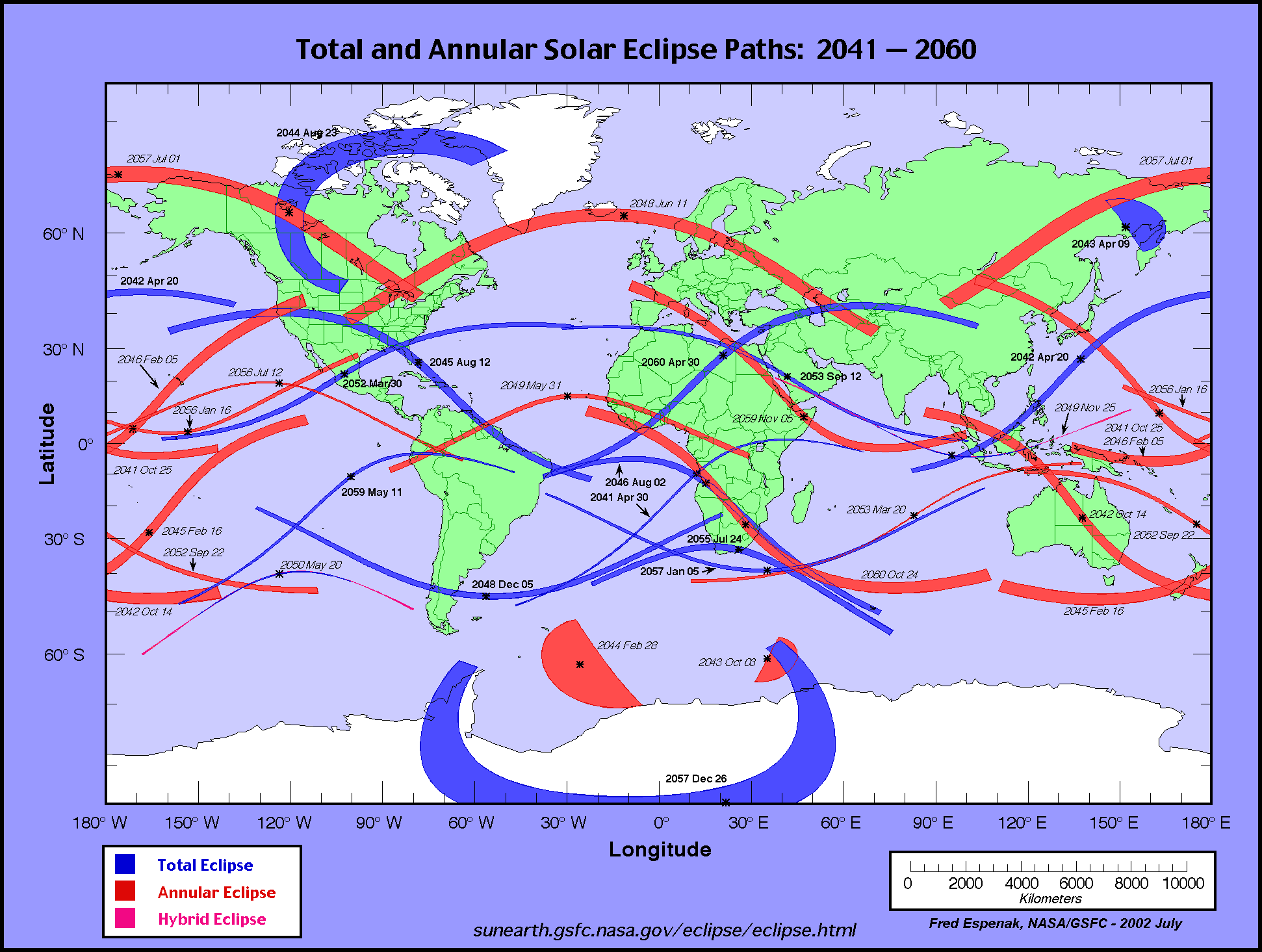
Assignment: The next Solar eclipse after these two that will cross the USA will be August 12, 2045. What states will it cross? And yes, I'll expect you to know the vocabulary words for a quiz.

be good,
Mr Hazen

Saturday, June 20, 2009

Farmer's Almanac

Included in a blogpost commenting about the unusual June weather here in the New York metropolitan area and global climate change in general was a link to the Farmer's Almanac long-range weather forcast
which is quoted below. The prediction covers the "Atlantic corridor" from Richmond to Boston.

Detailed Forecast for the Next Two Months


June 2009

Avg. Temperature: 73° (2° above avg.)
Precipitation: 2" (1.5" below avg.)
Jun. 1-4: Showers north; sunny, hot south


Jun. 5-8: Scattered showers, seasonable

Jun. 9-11: Sunny, comfortable

Jun. 12-15: Scattered t-storms, hot

Jun. 16-22: Sunny, warm

Jun. 23-27: T-storms, hot, then cooler

Jun. 28-30: Sunny


July 2009

Avg. Temperature: 74° (2° below avg.)
Precipitation: 3" (1" below avg.)
Jul. 1-6: T-storms, cool


Jul. 7-12: Sunny, very warm

Jul. 13-19: Showers, warm, then cool

Jul. 20-22: Scattered t-storms, hot

Jul. 23-26: Sunny, cool

Jul. 27-31: T-storms, cool

Temperature and Precipitation
November 2008 to October 2009


But according to our friends at NOAA 's National Weather Service as of June 19 we are 5.2 inches of rain above normal and 2 degrees below normal. That's a pretty big miss for the venerable almanac. But in fairness that's only one month so how did they do in the other months? (this is the part where my students would get to work researching, making tables and graphs and analyzing data...)

For May NWS reported precipitation .48 inches above normal, another miss for the almanac.
For April NWS reported precipitation .40 inches above normal, another miss for the almanac.

As the records back farther than 2 months are for sale (and I can't afford them) I can't go back further today (feel free to send a check) but we can keep track from this day forward easily enough.


So don't be shy, set up a little spreadsheet and go to the NWS Climate page and keep track of how the Farmer's Almanac does OR see how well the experts do by checking on the NWS predictions for the next three months.

Have fun!

Mr Hazen